Your food cost is running at 28–35% of revenue and you know waste is a big chunk of it. You’ve been searching for the best AI food waste reduction tools for restaurants — and a sales rep just sent you a demo request for a smart bin with a camera. It costs somewhere in the neighborhood of $10,000 to install, and the ROI deck looks incredible.
Before you book that call: the ROI deck is real — for hotel F&B operations throwing away 300 kilos a week. For your 45-seat neighborhood restaurant? The math is different, and nobody in that demo is going to tell you that.
Here’s the honest answer: for most independent restaurants (1–3 locations), software-first forecasting tools like Lineup.ai ($79–$149/month) will reduce waste more cost-effectively than hardware-heavy trackers like Winnow or Leanpath, which are designed and priced for chains and institutional accounts. The exception is if you’re running high-volume kitchen operations — hotel F&B, university dining, large catering — where hardware-first trackers genuinely earn back their cost fast.
Below, we break down the six most-used AI food waste tools across three categories — hardware-first trackers, software-first forecasting, and inventory management — with honest pricing, size fit, and a plain-language verdict for each.
The Two Ways AI Reduces Restaurant Food Waste (And Why the Distinction Matters)
Most content about AI food waste tools throws Winnow, Leanpath, Lineup.ai, and WISK into the same list as if they do the same thing. They don’t.
There are two fundamentally different approaches, and understanding which one you’re buying matters more than any feature comparison.
Approach 1: Hardware-First Waste Tracking (Winnow, Leanpath, Orbisk)
Cameras and scales sit over your waste bins. Every time something gets thrown out, the system identifies the food by type and weight and logs the discard. Over time, you accumulate data on what you’re wasting, when, and how much.
This is reactive intelligence. It tells you what happened after it already happened.
It’s powerful — genuinely — when you’re processing hundreds of discards a day across a large kitchen. At that volume, the patterns become actionable: “You’re discarding 40 lbs of prepped vegetable mise en place every Thursday night. Your Thursday prep guide is wrong.”
Approach 2: Software-First Forecasting (Lineup.ai, 5-Out)
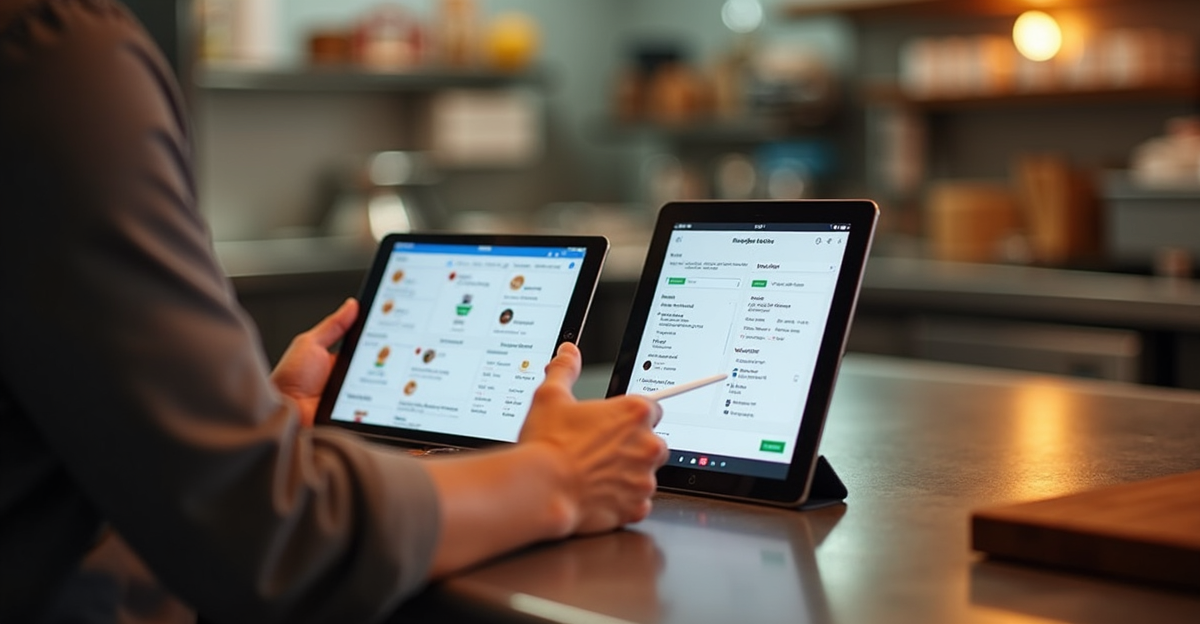
Connect to your existing POS. The system analyzes your historical sales data alongside external factors — weather, local events, day-of-week patterns — and tells you exactly how much to prep for each service before you cook anything.
This is proactive intelligence. You reduce waste before it happens by not making it in the first place.
| Waste Tracking | Demand Forecasting | |
|---|---|---|
| When does it help? | After waste occurs | Before prep begins |
| What does it measure? | What you threw away | What you’ll actually sell |
| Hardware required? | Yes (cameras, scales) | No (uses existing POS) |
| Best for | High-volume kitchens (hotels, catering, universities) | Independent restaurants with any modern POS |
| Staff involvement | Low-to-none (touchless options) | None — system runs in background |
Approach 3: Inventory Management (WISK.ai, MarketMan, xtraCHEF)
This is a third, separate category. These tools don’t track waste bins or forecast demand — they tighten your purchasing and stock controls so you buy what you need and track what you use. Waste reduction is a downstream benefit of not over-ordering and not having unaccounted stock disappearing.
Here’s the thing: a waste tracking system is only as good as its adoption rate. As Xenia.team’s operational analysis notes, “if your team finds workarounds or ignores it entirely, you’re paying for expensive data collection, not waste reduction.” Software-first tools sidestep this problem entirely — there’s nothing for your team to ignore.
Our honest take: For a 40-seat independent restaurant, the smarter AI play is forecasting — stop making the waste in the first place. Don’t film what goes in the trash and then analyze the footage.
Hardware-First AI Waste Trackers: Winnow, Leanpath, and Orbisk Compared
These three are the most-used hardware-first waste tracking platforms. They’re legitimately impressive tools. They’re also, in most cases, not designed for you if you’re running an independent restaurant.
Winnow
Winnow offers four product tiers, from Winnow Tablet (staff manually log waste on a touchscreen) up to Winnow VisionAI+ (fully touchless AI camera recognition that identifies food by type without any staff input).
The tech is solid. The case study results are real. Winnow documents 2x–10x ROI within year one for high-volume clients (Winnow Solutions/TrustRadius). Companies like IKEA Food Services and Compass Group use it at scale.
No public pricing. Enterprise-custom quote required. That’s not a minor detail — it means a multi-week sales cycle before you know whether it fits your budget.
Leanpath
Leanpath has three hardware form factors: Leanpath 360-AI (their flagship, AI-powered weighing station with food recognition), Scout (portable, handheld for satellite kitchens), and Lite (entry-level for smaller operations).
Their case study library is excellent and transparent. Arizona State University documented 39% waste reduction and 89,000 lbs of food saved in one year (Leanpath case study library). Sheraton Grand Hotel & Spa Edinburgh saw 64% reduction in food waste value and 58% reduction by weight in approximately 14 months (Leanpath).
Again: a university dining operation and a luxury hotel. The volume at these accounts makes the pattern data meaningful.
No public pricing.
Orbisk
Orbisk is newer to the US market (Dutch origin, recent US expansion) and works differently than the others. A computer vision camera sits on top of your waste bin, identifies every food item discarded down to ingredient level, and logs it automatically. No staff input required at all.
The hardware is included in their subscription — no upfront purchase cost, which is different from the others. Their FAQ describes the cost as “typically much cheaper than other solutions.” The company claims up to 70% food waste reduction for restaurant clients (Sama.com/Orbisk AI case study).
No public pricing, but the included-hardware model makes it more accessible for smaller accounts. Worth a conversation if you’re curious about hardware-first tracking.
The Comparison at a Glance
| Winnow | Leanpath | Orbisk | |
|---|---|---|---|
| Hardware included? | No (installed separately) | No (installed separately) | Yes (in subscription) |
| Pricing model | Custom enterprise quote | Custom enterprise quote | Custom quote (sub-based) |
| Staff input required? | VisionAI+: none; others: some | Scout: some; 360-AI: minimal | None (fully touchless) |
| Best for | Multi-location chains, QSRs | Institutional: hotels, universities | Smaller high-volume kitchens |
| Known results | 2x–10x ROI (high-volume) | 39–64% waste reduction (institutional) | Up to 70% reduction (restaurant) |
The honest question to ask any of these vendors: “What is the minimum monthly food spend where your tool makes sense?” If they dodge it, keep walking. A 40-seat independent generating $800K/year in revenue may not be generating the discard volume needed to make pattern data actionable.
Software-First Forecasting Tools: Lineup.ai and 5-Out
These two take the opposite approach: use your existing POS data to predict what you’ll sell, so you prep and order accordingly.
No hardware. No cameras. No installation. Just a connection to the system you already use.
Lineup.ai
Lineup.ai publishes its pricing — which, in this category, is genuinely unusual and worth calling out.
- Forecasts Only: $79/location/month
- Forecasts + Scheduling: $149/location/month
- (Source: lineup.ai/pricing)
Connect your POS, and Lineup.ai generates sales forecasts and prep guides — documents that tell your team exactly how much of each item to prep for each service. The waste reduction mechanism is direct: you stop making 40 portions of salmon on a Tuesday when the forecast says you’ll sell 18.
No sales call required to evaluate. No “contact us for pricing” runaround. You can sign up and see how it performs against your actual POS data before committing to anything.
That matters. Independent operators don’t have 3 weeks to go through an enterprise demo cycle.
5-Out
5-Out uses the same forecasting approach — historical POS data plus external factors (weather, local events) — but skews more toward labor scheduling as a paired benefit alongside waste reduction. They claim up to 98% forecast accuracy.
Pricing isn’t public — custom quote required. That said, users on Capterra describe the forecasts as “accurate right from the beginning. I trust 5-Out’s forecasts because I have never had reason not to.” That kind of review is harder to fake than a percentage claim.
5-Out is worth evaluating if labor scheduling is as much a priority as waste reduction for you.
Don’t Buy Before You Check Your POS
If you’re already on Toast, check whether Toast IQ covers demand forecasting in your current subscription before adding another tool. xtraCHEF (acquired by Toast) handles recipe costing and purchasing analytics that overlap with this category. You may already be paying for forecasting capability you haven’t turned on.
Our take: Lineup.ai wins the independent restaurant category on pricing transparency alone. $79/month with published pricing and no sales cycle required — that’s the right model for this customer. Reducing waste before it happens is better than measuring it after, and Lineup.ai is the lowest-friction way to start.
Inventory Management as Waste Reduction: WISK.ai and POS-Native Options
WISK.ai gets mentioned in a lot of AI food waste tool lists, and it deserves a clear-eyed description of what it actually does.
WISK is an inventory management platform. Primarily bar and restaurant inventory. It doesn’t track what goes in your waste bin. It doesn’t forecast demand. What it does: count your stock faster and more accurately, reconcile actual usage against theoretical usage, and flag the gap — which shows up as over-pouring, spillage, theft, or over-ordering.
Closing that gap is genuine waste reduction. It’s just a different mechanism.
WISK pricing (from help.wisk.ai and third-party reviewers):
- Bar Essentials: ~$199–$249/month
- F&B Professional: ~$349–$399/month
- Enterprise: custom quote
- 14-day free trial available
- Integrates with 50+ POS systems
WISK users on G2 and Capterra report up to 10% food cost reductions, 5x faster inventory counts, and 99.7% claimed accuracy. On the negative side: some users flag technical issues and data sync problems. It’s a solid tool, not a perfect one.
Other inventory tools in this category:
- MarketMan: ~$239/month starting, focused on multi-location operators
- xtraCHEF/Toast: already mentioned above — strong if you’re in the Toast ecosystem
- Craftable: similar category, popular with bar-focused operations
Our take: WISK is worth its cost if you’re running a full-service restaurant or bar with serious beverage inventory. But don’t let anyone sell it to you as a food waste AI tool. It’s a different job — a valuable one, just different.
Our Take: Which AI Food Waste Tool Is Right for Your Restaurant?
Here’s the thing most AI food waste content won’t tell you: the majority of it is written for enterprise buyers. The tools with the biggest marketing budgets (Winnow, Leanpath) are designed for chains and institutional operators. Their ROI case studies feature Arizona State University and IKEA. Your 12-table neighborhood Italian place is not Arizona State University.
The biggest waste win for independent restaurants isn’t a camera watching your trash can. It’s finally knowing you’ve been over-prepping salmon every Tuesday.
For a 1–3 location independent restaurant: Start with Lineup.ai at $79–$149/month. Connect it to your POS. Run two weeks of demand forecasts. The gap between what your team actually prepped and what the forecast says you needed — that gap is your baseline waste number. Close it. If you’re on Toast, check Toast IQ first.
For a bar-forward or full-service independent: Add WISK.ai on top of demand forecasting. Knowing what to prep AND knowing what you actually used gives you the full picture — over-prep waste on one side, inventory shrinkage on the other.
For a high-volume kitchen (hotel F&B, university dining, large catering operations): Orbisk or Leanpath are worth serious evaluation. You’re throwing away enough volume that the pattern data becomes actionable fast. Ask for a break-even analysis at your specific daily covers before signing anything.
For a growing chain (5+ locations, $5M+ in annual F&B revenue): Winnow’s VisionAI tier becomes genuinely competitive. Cross-location data starts generating the kind of operational insights that justify enterprise pricing.
What we’d skip: Any vendor who can’t give you a clear answer on what annual food spend is needed to hit break-even. The AI food waste space has real solutions and real gimmicks. If the demo spends more time on sustainability impact than ROI math, ask the hard question: “At my volume, when do I break even?” If they stumble, that’s your answer.
The contrarian thesis: most independent restaurants don’t need to track waste. They need to stop making it. Those are solvable with very different tools, and the cheaper one usually wins.
Frequently Asked Questions
Which AI food waste tools actually work for small independent restaurants vs. large chains?
Software-first forecasting tools — Lineup.ai and 5-Out — work for independents. They connect to your existing POS, require no hardware installation, and are priced at a scale that makes sense for single-location operations. Hardware-first trackers (Winnow, Leanpath, Orbisk) are optimized for high-volume kitchens where the data density justifies the cost. If you’re leaning toward hardware anyway, Orbisk is the most accessible option for smaller accounts since the hardware is included in the subscription rather than purchased separately.
Do I need expensive hardware (smart bins, cameras) or is a software-only approach good enough?
For most independent restaurants, software-only isn’t just “good enough” — it’s probably better. Demand forecasting prevents waste before it occurs; hardware trackers measure it after. A rough guide: if you’re spending less than $1M annually on food, the ROI math on hardware-first tools gets tight fast. Start with forecasting. You can always add hardware later if the data shows you need it.
How much do AI food waste reduction tools cost for a small restaurant?
Lineup.ai: $79–$149/month per location (published pricing, no sales call required). WISK.ai: $199–$799/month depending on tier (14-day free trial available). 5-Out, Winnow, Leanpath, and Orbisk all require a custom quote — meaning a demo before you see pricing. For any tool with opaque pricing, push the vendor for a break-even analysis at your specific volume before you sign. If they won’t provide one, that’s a red flag.
What is the realistic ROI and payback period on AI food waste software?
Leanpath’s documented case studies show 20–50% waste reduction in year one for institutional accounts. Winnow documents 2x–10x ROI for high-volume clients (TrustRadius/Capterra verified reviews). The widely-cited “7:1 benefit-cost ratio” comes from WRAP/Champions 12.3 hospitality sector data — it’s a sector average, not a per-restaurant guarantee. For software-first forecasting tools, the ROI calculation is simpler: $79/month against how much your current over-prep costs you. For a restaurant wasting $2,000/month in prep, a 20% reduction more than covers the tool.
Can I use my existing POS data to reduce food waste without buying new hardware?
Yes — this is exactly what Lineup.ai and 5-Out do. They connect to your POS and use your historical sales data to generate prep forecasts. If you’re on Toast, check Toast IQ and xtraCHEF first — there’s a real chance you’re already paying for forecasting features you haven’t activated. Demand forecasting is one of the most underused capabilities in modern POS systems.
What’s the difference between waste-tracking tools (Winnow, Orbisk) and demand-forecasting tools (5-Out, Lineup.ai)?
Waste trackers tell you what you wasted and why — reactive intelligence that’s most useful when you’re processing high discard volumes and need pattern data to change your prep and purchasing guides. Demand forecasting tools tell you how much to prep and order before service — proactive intelligence that prevents waste from occurring. Both reduce waste, but from opposite ends of the kitchen workflow. Trackers are better for high-volume operations with identifiable waste patterns. Forecasters are better for restaurants whose core problem is over-ordering and over-prepping to avoid running out.
Start Here, Not With the Demo
For independent restaurants, the biggest AI win in food waste reduction isn’t a camera watching your trash can. It’s finally knowing you’ve been over-prepping salmon every Tuesday for the last eight months.
Start with Lineup.ai’s free trial: connect it to your POS, run two weeks of demand forecasts, and compare what your team actually prepped to what the data suggests. That gap is your baseline. Closing it costs $79/month.
If you’re evaluating hardware-first trackers, don’t skip the break-even question. Get Orbisk, Leanpath, or Winnow to give you a number: “At my daily covers, when do I break even?” A good vendor will answer that question directly.
The best AI food waste tool is the one your team will actually use — and that starts with the one that doesn’t require a $10,000 sales cycle just to find out if it fits your budget.