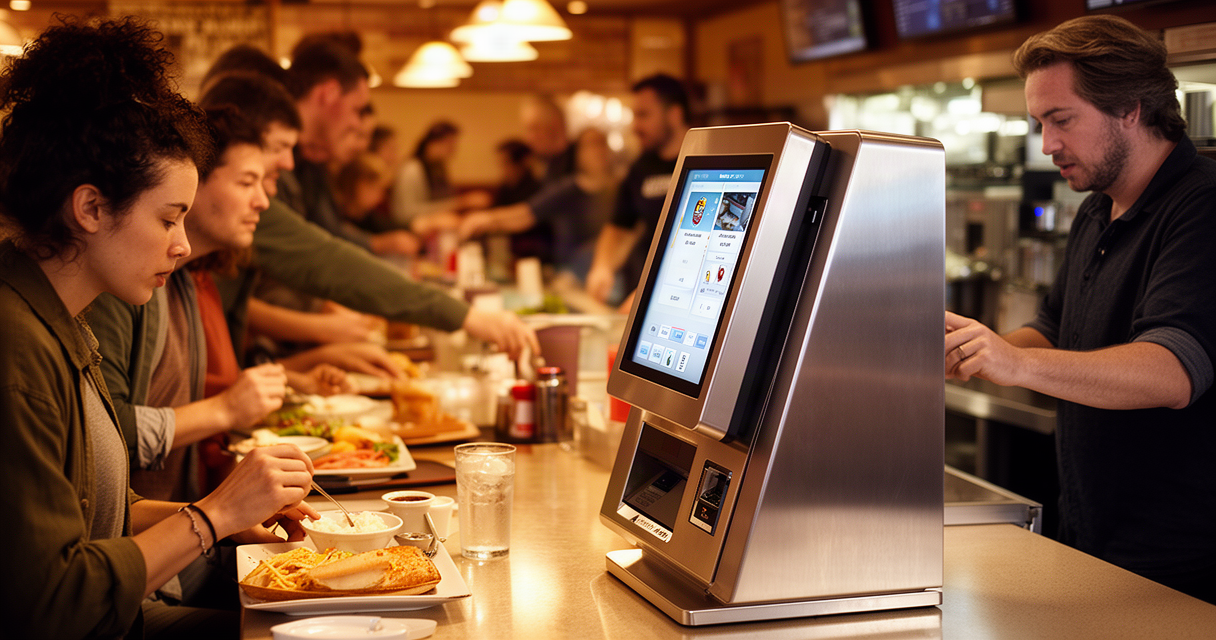
Every kiosk vendor pitch sounds the same: switch and watch average ticket size jump 20%, 30%, sometimes more. Most of those pitches are built for a 40-seat QSR chain running 300 covers a day, not a single-location counter-service spot doing a fraction of that volume.
The stakes are financial, not theoretical. Kiosk software fees stack on top of an existing POS bill whether or not they earn their keep — $50 to $200-plus a month for a feature Square may already include for a lot less.
The quick answer: a modest-volume single-location restaurant already on Square covers roughly 90% of what it needs with Square’s own Kiosk mode, at about $30-50 a month per device. KioskBuddy is worth the extra layer for a friendlier guest-facing screen without leaving Square. Toast Kiosk and GRUBBRR only make sense on Toast, or at genuinely high volume.
What each option actually costs in 2026, what real operators report, and the volume point where paying more than Square Kiosk starts to pay off, follow below.
Quick Verdict: Do You Even Need to Leave Square Kiosk?
For most single-location independents already running Square vs Toast vs Clover as the POS backbone, the answer is no. Square’s native Kiosk mode is included in the same ecosystem, costs less than any third-party layer, and does the core job: let a guest order and pay without a staffed register.
The case for switching gets stronger only under specific conditions: consistent peak-hour lines that a second register would otherwise handle, a UI limitation that’s actively costing orders, or a POS migration that’s happening anyway. None of those conditions are universal, and vendor sales decks tend to treat them as if they were.
The rest of this piece sorts the five options — Square Kiosk, KioskBuddy, Toast Kiosk, GRUBBRR, and INFI — against real 2026 pricing and what operators say about each once the sales call is over.
Square Kiosk vs KioskBuddy vs Toast Kiosk vs GRUBBRR vs INFI: 2026 Pricing Compared
| Option | Monthly Software Fee | Hardware Cost | POS Lock-In | Cash Acceptance | Best For |
|---|---|---|---|---|---|
| Square Kiosk | About $30-50/mo per device | Square Stand from $149 | Square only | Card/NFC only | Modest-volume, already on Square |
| KioskBuddy | About $50/mo | Uses existing Square hardware or third-party tablet | Square only (layers on top) | Card/NFC only | Square users wanting a nicer guest UI |
| Toast Kiosk | About $69/mo (Core plan) | Toast Flex terminal, about $1,024-$1,300 upfront | Toast only | Card/NFC only | Restaurants already committed to Toast |
| GRUBBRR | Starts at $199/mo (1-2 kiosks) | $2,500-$3,500 per unit | Integrates 93+ POS systems | Card/NFC only | High-volume, multi-unit operators |
| INFI | About $50-$200+/mo per kiosk | $700-$2,000 countertop; $2,500-$5,000 freestanding | Layers on existing POS, incl. Square | Card/NFC only | Operators wanting AI upsell layered on current POS |
Pricing pulled from Square’s own pricing pages, KioskBuddy’s product page, Toast’s pricing page plus Merchant Maverick’s Toast pricing guide, GRUBBRR’s site and Capterra listing, and INFI’s site — all checked 2026-09-17. Square location plans run Free ($0), Plus ($49/mo), and Premium ($149/mo), with in-person processing sliding from 2.6%+15c down to 2.4%+15c as the plan tier rises.
Square Kiosk: What It Does and Where It Falls Short
Square Kiosk turns an existing Square Stand or iPad into a self-order screen, pulling directly from the Square catalog and menu already in use. There’s no separate system to sync, no second vendor relationship, and no migration.
Restaurant operators on r/restaurateur describe cobbling together their own version rather than buying a dedicated product: “We use Square and have a Square register set up as a self-serve kiosk. Not quite what your looking for but it is a way to set up a kiosk and stay within Square. We also use Square online ordering and Square KDS. Works really well for us!” That pairing — a kiosk-mode register plus a kitchen display system — is the setup most single-location Square shops land on.
It’s not friction-free. One operator on r/restaurateur ran into permission and lockdown issues trying to run the iPad-based version: “we did attempt the iPad kiosk with Square. We got it working ok but not perfectly with a combination of user permissions and the guided access iPad feature. I forget what feature we couldn’t lock down that made us switch to the register.” The workaround — using a dedicated Square Register instead of a general-purpose iPad — solved it, but it’s a real setup cost worth budgeting time for.
The other limitation is reported platform fragmentation: the kiosk app skews iOS while Square KDS skews Android, meaning a kitchen already standardized on one ecosystem may need a second device type just for the kiosk. That’s a manageable annoyance at $30-50/mo, not a reason to leave Square outright — but it’s the crack that KioskBuddy is built to fill.
KioskBuddy: The Cheaper Way to Upgrade the Guest-Facing Screen Without Leaving Square
KioskBuddy doesn’t replace the POS. It imports the existing Square catalog and layers a more polished, guest-facing ordering screen on top, starting at around $50 a month.
For a restaurant whose main complaint with Square Kiosk is the interface itself — clunky modifier flows, a layout that wasn’t designed for a self-order screen — KioskBuddy is the lower-cost fix. It doesn’t require moving off Square, re-training staff on a new backend, or buying new terminal hardware.
The tradeoff is stacking cost. Square Kiosk’s own $30-50/mo fee plus KioskBuddy’s roughly $50/mo means a restaurant is now paying two software line items to solve a UI problem. For an operation where the native Square kiosk mode already functions — clunky or not — that extra $50/mo needs to be justified by a measurable order-time or accuracy improvement, not just a nicer-looking screen.
Toast Kiosk: Only Makes Sense If You’re Already on Toast
Toast Kiosk requires the Toast POS underneath it — there’s no version that layers onto Square or Clover. That’s the single biggest gate on this option: it’s not really a Square alternative so much as a reason to consider leaving Square for Toast entirely, which is a much bigger decision.
At roughly $69/mo on Toast’s Core plan, the software fee runs higher than Square Kiosk’s, and the Toast Flex terminal hardware costs $1,024-$1,300 upfront per unit — several times a Square Stand. Processing runs 2.49%+$0.15 per order, per Toast’s own pricing page and Merchant Maverick’s Toast pricing breakdown.
For a restaurant already weighing a full POS switch, the full TouchBistro vs Toast comparison is the more useful starting point than evaluating Toast Kiosk in isolation — the kiosk decision should follow the POS decision, not lead it. Migrating an entire POS system just to unlock a kiosk feature is an expensive way to solve a problem Square’s native kiosk mode may already handle.
GRUBBRR: Built for High-Volume Operators, Not Single-Location Independents
GRUBBRR’s pricing signals exactly who it’s built for. Hardware runs $2,500-$3,500 per unit, and software starts at $199/mo for just one or two kiosks, according to GRUBBRR’s own site and its Capterra listing. That’s before adding the AI-driven upsell and loyalty features the platform markets as its differentiator.
The 93-plus POS integrations are a genuine strength for a multi-unit operator standardizing kiosk hardware across locations running different back-end systems. For a single independent restaurant, that flexibility is mostly wasted — there’s only one POS to integrate with, and it’s probably already Square.
The AI upsell mechanics GRUBBRR leans on in its marketing are the same mechanics behind every “kiosks increase check size” claim in the category. The evidence for how well that translates outside a QSR chain environment is thin, and worth treating skeptically before signing a $199-plus/mo contract on the strength of it.
INFI: A Middle Ground That Layers on Top of Your Existing POS
INFI sits between KioskBuddy’s light-touch UI layer and GRUBBRR’s full high-volume system. Like KioskBuddy, it layers on top of an existing POS — including Square — rather than replacing it. Hardware ranges from $700-$2,000 for a countertop unit up to $2,500-$5,000 for a freestanding kiosk, and software runs about $50-$200-plus a month per kiosk, per INFI’s own site.
INFI markets a 6-18 month payback period based on AI-driven upsell performance. That’s a vendor estimate, not an independently verified figure, and it should be read that way — no third-party source in this research confirms it holds across restaurant types or volumes.
The pricing spread is wide enough that INFI can land anywhere from “slightly more than KioskBuddy” to “approaching GRUBBRR territory,” depending on hardware choice and kiosk count. For an independent restaurant, the freestanding hardware tier in particular is hard to justify without the order volume GRUBBRR is built for.
Our Take: The Order-Volume Threshold That Actually Matters
The honest driver behind a kiosk upgrade isn’t the vendor’s upsell-percentage slide. It’s whether the restaurant is regularly short a register during its busiest window.
Community evidence on this is more useful than any vendor deck. One operator on r/restaurateur ran a school-site kiosk and did the math after the fact: “previously we had on site kiosk at one of the schools, but an extra (these are rough numbers) $240 in sales to pay $170 in wages didnt make it worth while at the time.” That’s the actual test — incremental sales against the labor hours the kiosk replaces, not a marketing multiplier.
The upsell claims themselves get mixed reviews from the people the upsells are aimed at. A commenter on r/KitchenConfidential recalled the QSR version of this pitch from the customer side: “I used them a few times at KFC and went often for the small upsell option, I can’t even remember if the staff ever asked for it. It definitely often increased my spending by maybe 10%-15%. I wouldn’t want that in regular restaurants though.” A 10-15% self-reported bump at a national fast-food chain isn’t nothing, but it’s also not automatically transferable to a sit-down or fast-casual independent, where the same commenter draws a clear line against wanting the same treatment.
There’s a real customer-experience cost that shows up in these threads too. One frustrated diner on r/KitchenConfidential described a pizza order gone wrong: “I recently tried to order a pizza from a new place, QR codes, log in password, no humans so I went to my old place called and got a pizza… Older folks don’t like technology we like people.” That’s an anecdote, not data, but it lines up with a broader argument made on the same subreddit: “you’re selling an experience. Does having a fast and friendly improve the experience over a kiosk? Of course, but can you attract and retain someone like that, at a reasonable cost/effort?” That’s the real tradeoff — not “kiosk vs no kiosk” but “kiosk vs the cost of hiring and keeping good counter staff.” An AI drive-thru ordering layer runs into the same labor-substitution math, and it holds up better where staffing is the genuine bottleneck rather than where the line is short and manageable.
It’s also worth naming the noise in this space directly. As one r/restaurateur commenter put it about kiosk and ordering-app threads generally: “I love a thread where one app spammer posts and other related app spammers pretend they are restaurant owners/operators and have a pretend conversation.” Vendor-seeded enthusiasm in these threads is common enough that operator-reported specifics — costs, wage math, actual order counts — carry more weight than general praise.
For an operator actually piloting a kiosk, one comment on r/smallbusiness lays out the right test: “The biggest things to test in a pilot are modifier accuracy, staff fallback when the kiosk stalls, and whether the setup actually reduces counter time during the busiest 30 minutes of the day.” That’s a better framework than any vendor’s ROI calculator — measure the 30 minutes that actually matter, not a projected annual lift.
The position this evidence supports: Square Kiosk (or KioskBuddy on top of it) is the right call for the large majority of single-location independents. GRUBBRR and the freestanding tier of INFI only clear their cost at a volume most independents don’t run.
Does Any Self-Order Kiosk Actually Accept Cash?
No, not meaningfully. Every option in this comparison — Square Kiosk, KioskBuddy, Toast Kiosk, GRUBBRR, INFI — defaults to card and NFC payment. Cash-accepting kiosk hardware exists in theory but is mechanically unreliable in practice and rarely worth the added cost and maintenance.
One r/restaurateur commenter put the industry reality bluntly: “Just look around. The only ‘kiosk’ taking cash are ATMs. Not even McDonald’s has kiosks that take cash… Your best bet is to go cashless.” That’s the standard almost every operator in this category has settled on: kiosks handle card orders, and a manned register stays available as the cash-accepting fallback.
Frequently Asked Questions
Is a self-order kiosk actually worth it for a small single-location independent restaurant, or is it built for higher-volume QSR chains?
Kiosk hardware and the vendor sales pitch behind it are built primarily for higher-volume QSR and fast-casual chains. It’s worth it for an independent restaurant mainly once the restaurant is consistently short a second register during peak hours. Below that threshold, Square’s native kiosk mode covers the need.
What does Square Kiosk NOT do that pushes owners to alternatives like KioskBuddy or Toast Kiosk?
It’s locked to Square POS, the kiosk app is reported to run best on iOS while Square KDS runs on Android — creating a two-ecosystem hardware requirement — and its guest-facing interface is more basic than dedicated kiosk products. KioskBuddy adds UI polish on top of Square without switching systems; Toast Kiosk requires migrating to Toast entirely.
How much does a restaurant self-order kiosk really cost per month once hardware, software, and processing are added up?
Square Kiosk runs about $30-50/mo in software plus $149-plus in hardware and 2.4-2.6%+15c processing. KioskBuddy adds about $50/mo on top of Square. Toast Kiosk runs about $69/mo plus $1,000-$1,300 in hardware and 2.49%+15c processing. GRUBBRR starts at $199-plus/mo plus $2,500-$3,500 hardware. INFI runs about $50-$200-plus/mo plus $700-$5,000 in hardware depending on the format.
Do self-order kiosks accept cash, or are most card-only?
Almost all kiosks default to card and NFC payment only. Cash-accepting hardware exists but is mechanically unreliable and rarely worth the added expense — most operators go cashless at the kiosk and keep a staffed register as the cash backup.
At what order volume does a dedicated kiosk pay for the extra monthly fee?
There’s no universal number, and vendor-claimed 6-18 month paybacks or 25-50% ticket-lift statistics should be treated as marketing claims rather than guarantees. The working rule from operator experience: if the incremental sales a kiosk generates don’t clearly exceed the labor cost of the staff hours it replaces — as in the r/restaurateur case where $240 in extra sales cost $170 in wages — the kiosk isn’t paying for itself yet.
The Kiosk That’s Worth Buying Is the One That Matches the Line, Not the Slide Deck
Most single-location independents already running Square don’t need to leave Square Kiosk. The upgrade to KioskBuddy, Toast Kiosk, GRUBBRR, or INFI only pays off once order volume — not vendor hype — demands it.
Before taking a demo call from any of these vendors, price the peak-hour labor cost a kiosk would actually offset against Square Kiosk’s $30-50/mo fee. That single comparison settles most of these decisions faster than any feature list.
The kiosk that pays off is the one that matches the line at 12:15pm on a Saturday, not the one with the best upsell slide deck.